How to distinguish the authenticity of China supplier qualification certificates?
Question
A Zhejiang supplier sent me scanned copies of a bunch of qualification certificates, including ISO 9001, CE certification and a certificate that looked like a "high-tech enterprise" issued by the government. I am not sure whether these certificates are authentic and valid, and I want to know what methods can tell if they are authentic.
Answers (1)Write Your Answer ↓
Fraud of qualification certificates is not uncommon among suppliers around the world, and China is no exception, but the good news is that most certificates have official verification channels, and it can be verified in a few minutes.
Let's talk about ISO system certification first. ISO 9001, ISO 14001 certificates will be recorded. After you get the scanned copy of the certificate, first look at the name of the issuing agency and the certificate number, and then go to the official website of the certification agency or the query system of the China National Accreditation Service for Conformity Assessment (CNAS) to enter the certificate number. If it cannot be found, or the information found is inconsistent with the company name and certification scope on the scanned copy, there will be a problem.
We have encountered suppliers who changed their names and sent them over with certificates from other companies. If you check the numbers, you will find that the information does not match.
CE certification is relatively complex. The CE mark is not a certificate, but a declaration of conformity that needs to be evaluated by a Notified Body. A real CE certificate will have a 4-digit notified body code. You can go to the EU's NANDO database to check the institution corresponding to this code, and then contact the institution to verify the certificate. We have encountered situations where suppliers themselves have posted a CE mark and certificate number, but the number does not correspond to any notified body at all.
"high-tech enterprise" is a qualification jointly recognized by the Ministry of Science and Technology, the Ministry of Finance, and the State Administration of Taxation of China. After recognition, enterprises enjoy tax incentives. There is a list for this accreditation. You can enter the company name on the Ministry of Science and Technology Government Service Platform to inquire. If the other party says that he is high-profile but cannot be found online, it is false. In addition, note that the validity period for high-level qualifications is three years, and it is also common for them to be reported after they expire.
There is also a tip. A scanned copy of a real certificate usually has a clear watermark, official seal of the issuing authority, issuance date and validity period. If the scanned piece is blurred, the position of the official seal looks unnatural, and it is still in use after the expiration date, these are all signals. In addition, many suppliers will send more than a dozen certificates in one go, but if you look carefully, they are all issued in the same year or even the same template, the gold content of such batch certificates will be discounted.
When we make the verification report, we will verify each certificate one by one. From our historical verification records, it is not uncommon for suppliers to exaggerate or falsify their qualification certificates to varying degrees. So don't just take a look at the certificate and rest assured when you receive it. Spend a few minutes checking the number. This action is extremely low-cost but has a high yield.
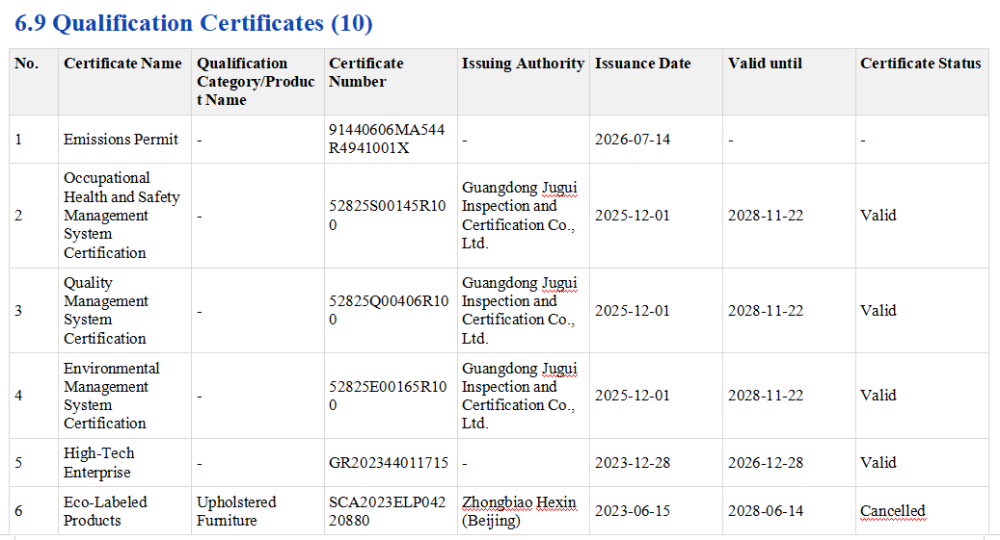
Item 6.9 (Qualification Certificates) in the company's credit report issued by CheckChinaCompany will display publicly available qualification certificates of the company. You can check whether the qualification certificates provided by suppliers are in the list. If they are not displayed, you need to find the unit that issued the qualification certificate separately to verify. If the company provides many qualifications, you can select the more important ones and conduct random inspections.
People Also Ask
Does a valid certificate mean that the supplier actually has the production capacity?
A valid certificate only indicates that the company meets the qualifications on paper; it does not guarantee that the factory's actual production meets the standards. Some companies do not follow the standards in their actual production after obtaining the certificate. It is best to combine this with a video tour of the factory to further verify the actual production conditions.
Could the translated version of the certificate provided by the supplier contain altered content?
The translated version itself cannot be used as a basis for verification; it is only for reference by overseas customers. You must request the original Chinese certificate and verify the certificate number in the official system. Translated versions may contain modified terms and cannot be used alone to determine authenticity.
If a certificate cannot be found in the system, does that necessarily mean it is a fake?
It is not necessarily a forgery; in rare cases, there may be a delay in updating the system data. Check to see if the company name or certificate number was entered incorrectly, and try searching again in a few days. If multiple searches still yield no results, the certificate is most likely not credible.